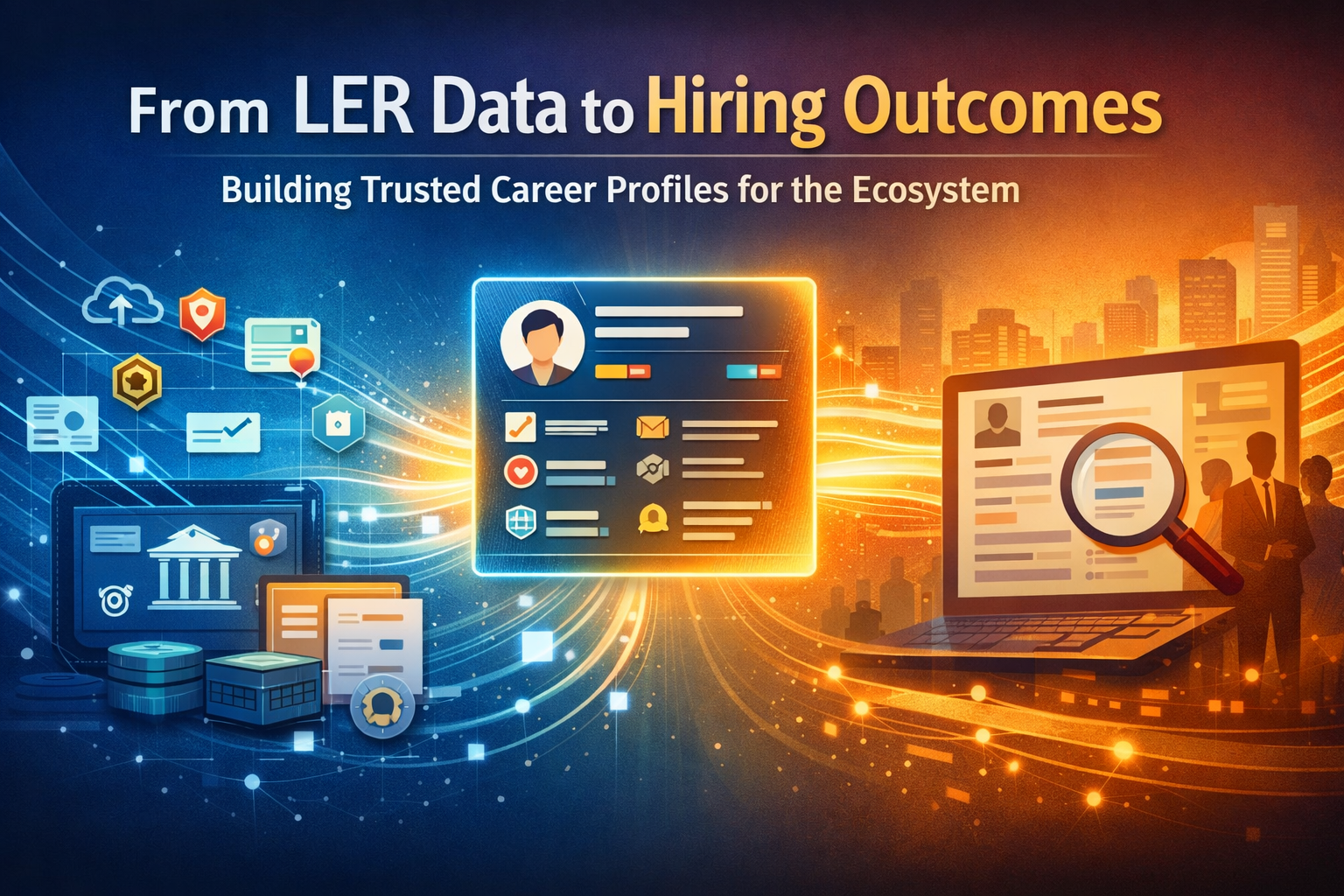
The Learning and Employment Record (LER) ecosystem has reached an important inflection point.
Over the past several years, the field has made meaningful progress on standards, credential issuance, identity frameworks, and learner-controlled data. Education institutions, workforce organizations, employers, and technology providers are increasingly aligned around a shared belief: verified, portable records can create more equitable and efficient pathways from learning to work.
And yet, for all of this momentum, one critical question remains unanswered:
How does LER data actually get used in hiring?
The LER Ecosystem Is Maturing — But Value Is Still Latent
The latest LER ecosystem research shows a landscape rich with innovation. Issuers are producing digital credentials at scale. Standards bodies and infrastructure providers are enabling interoperability. Wallets and registries are giving individuals greater control over their records.
What’s clear is that the ecosystem is no longer struggling with whether LERs can exist.
What’s less clear is where value is realized.
Because employers do not hire from registries.
They do not evaluate candidates by inspecting raw credentials.
And they do not change hiring behavior simply because better data exists.
Value only materializes when LER data is translated into formats and signals that align with real hiring workflows.
The Employer Adoption Gap Isn’t Resistance — It’s a Translation Problem
Much of the discussion around employer adoption frames the challenge as cultural or behavioral. In reality, it’s structural.
Employers hire using:
- resumes and profiles
- applicant tracking systems
- keyword search and screening tools
- human review under time pressure
LERs, by contrast, are:
- structured, multi-source data objects
- designed for verification and portability
- optimized for interoperability, not consumption
This mismatch doesn’t mean LERs are flawed. It means they’re incomplete without a layer designed to translate trusted data into employer-ready representations.
Reframing the Resume: From Self-Reported Artifact to Trusted Interface
In a skills-based economy, the resume doesn’t disappear — it evolves.
The resume has always served a critical function: compressing complex experience into a format that employers can quickly understand and evaluate. What’s changed is the quality of data behind it.
When resumes are built on top of verified credentials and structured records, they become:
- less reliant on self-assertion
- more consistent across systems
- more useful as hiring signals
In this model, the resume is no longer the end product.
It becomes the user interface for a deeper, trusted data layer.
SmartResume’s Path Toward Becoming a Trusted Career Profile Builder
This is where SmartResume sees a clear and necessary next step for the ecosystem.
Today, SmartResume brings together a wide range of inputs that make up an individual’s career story, including:
- Open Badges and other verifiable credentials
- Comprehensive Learner Records (CLRs)
- employer-issued records and work histories
- narrative experiences and projects
- structured self-attestations where verification is not yet available
These inputs are already synthesized into employer-ready resumes and profiles. But as the ecosystem matures, it is increasingly clear that the industry needs a shared, portable representation of that synthesis.
For that reason, SmartResume intends to support the Trusted Career Profile (TCP) standard.
Supporting TCPs by Producing Them First
SmartResume’s initial focus will be on producing Trusted Career Profiles from SmartResumes, enabling trusted data to move out of the platform and into the broader ecosystem.
This approach reflects a simple belief:
interoperability starts with export.
By converting SmartResumes into TCPs, we aim to:
- allow learners to carry structured career profiles across platforms
- enable downstream systems to consume verified resume data
- help test and refine the TCP standard through real-world use
This work positions SmartResume not as a closed destination, but as an active contributor to ecosystem interoperability.
Inviting the Ecosystem: Become a Destination for TCPs and SmartResumes
As part of this direction, we are inviting partners across the LER ecosystem to engage with us.
This includes organizations interested in:
- becoming destinations for Trusted Career Profiles
- consuming SmartResumes or TCPs in their platforms
- exploring new hiring, matching, or service delivery use cases
- collaborating on early implementations and feedback
Standards become durable when they are used — not just specified.
Looking Ahead: Ingesting TCPs as the Ecosystem Scales
Longer term, as Trusted Career Profiles become more widely adopted, SmartResume plans to support ingesting TCPs as inputs, allowing individuals to more quickly create or update SmartResumes from existing structured data.
In this future state:
- learners spend less time re-entering information
- issuers see their data flow into real hiring tools
- employers benefit from higher-quality, consistent profiles
This creates a virtuous cycle where TCPs both power resumes and are strengthened by resume-based hiring outcomes.
Inviting the Ecosystem: Who Should Engage and Why
As SmartResume begins work to produce Trusted Career Profiles from SmartResumes, we are intentionally opening this effort to collaboration across the LER ecosystem.
This invitation is especially relevant for organizations building systems where better career data directly improves outcomes. That includes applicant tracking systems looking for practical ways to introduce LER data into hiring workflows, reduce reliance on self-reported resumes, and improve screening and matching earlier in the hiring process. It also includes job boards and talent marketplaces that recognize growing employer demand for discovery and matching based on verified skills and experience, rather than keywords alone.
The opportunity extends beyond hiring platforms. Career planning and guidance systems can use richer, structured career profiles to deliver higher-quality recommendations and more clearly connect learning pathways to employment outcomes. Credit for prior learning platforms can leverage Trusted Career Profiles as a foundation for recognizing learning wherever it occurs and supporting true educational interoperability. Credential wallets and platforms with embedded learner services may also see value in moving beyond individual credentials toward more holistic, portable career profiles that enable new downstream services.
In each case, the opportunity is the same: shifting from isolated credentials to usable, portable career intelligence that can move across systems and support real decisions.
If you are interested in connecting SmartResume to your platform, please email ian@idatafy.com or hello@smartresume.com.
The Next Phase of the LER Ecosystem
The next phase of LER adoption will not be driven by more credentials alone. It will be driven by systems that connect trusted data to real economic decisions.
That requires:
- building for consumption, not just control
- designing interfaces employers already understand
- producing Trusted Career Profiles that can move across systems
LERs change the labor market only when they change hiring.
Building that bridge — from infrastructure to outcomes — is the work ahead.